3-minute read · Gladstone Technology Solutions
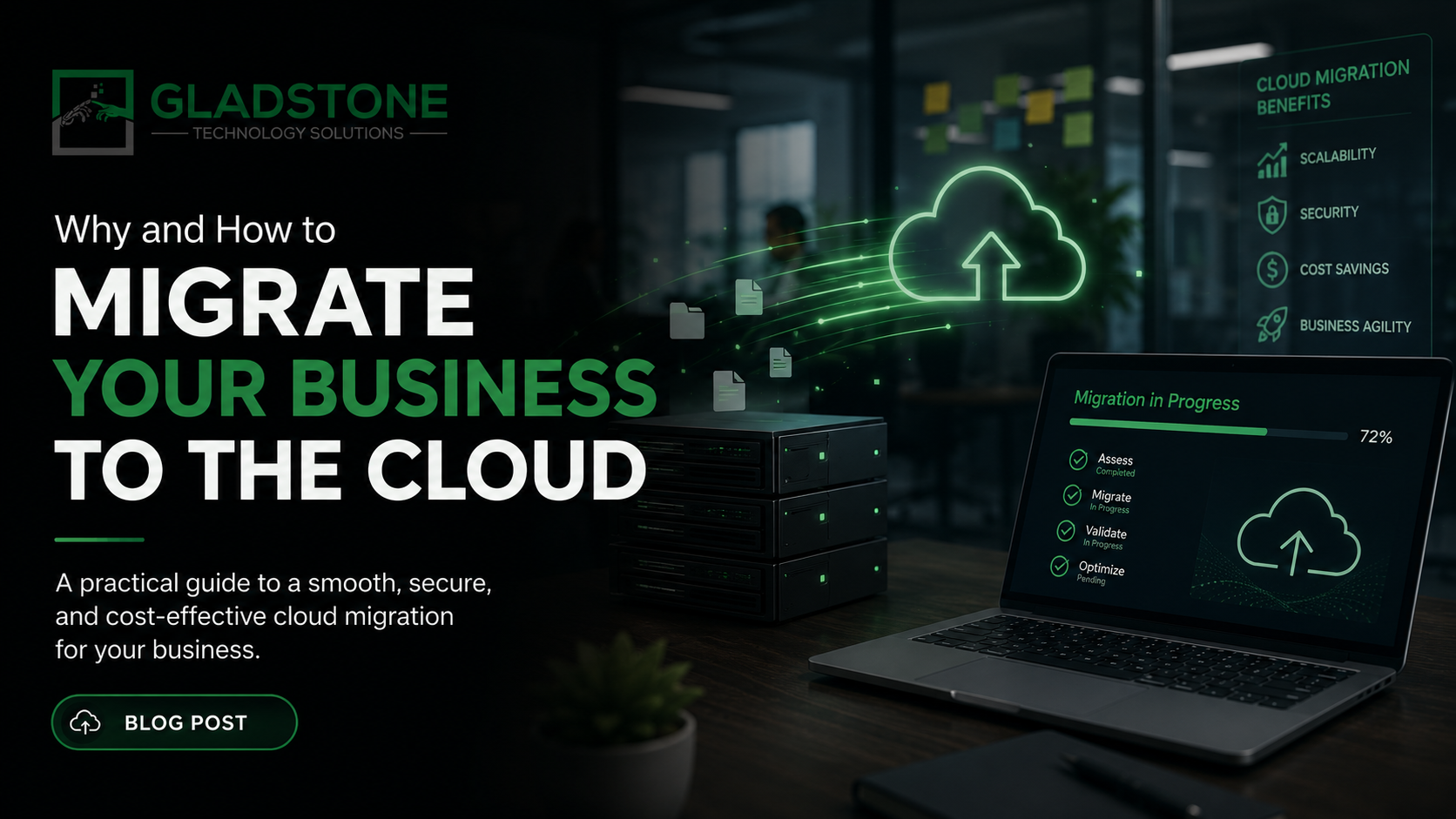
Cloud migration has become one of the most impactful decisions a business can make — and also one of the most misunderstood. Some business owners picture it as a complex, months-long technical upheaval. Others assume it's something only large enterprises do. Both assumptions are wrong.
Moving your business to the cloud is more accessible than it's ever been — and in most cases, the question isn't whether to migrate, but how to do it well.
Businesses that migrate to the cloud report an average 20–30% reduction in IT costs and a 70% improvement in business agility. (Deloitte Cloud Survey, 2023)
Beyond cost savings, cloud infrastructure gives businesses the ability to scale instantly, enable remote work without sacrificing security, and access enterprise-grade tools that would otherwise require significant capital investment.
Cloud migration is the process of moving your business data, applications, and infrastructure from on-premise hardware (physical servers, local storage) to cloud-hosted platforms. Depending on your starting point, this might mean:
The scope of migration varies by business — and the right approach depends on your current infrastructure, your industry, and your compliance requirements.
Cloud environments scale with your business. Adding users, storage, or compute capacity is a configuration change — not a capital expense. You pay for what you use, and you adjust as needs change.
Physical servers get damaged, stolen, or fail. Cloud infrastructure is geographically distributed and redundant by design. Most cloud platforms offer 99.9% uptime guarantees — a standard that on-premise hardware rarely matches.
Cloud-based systems are accessible from anywhere with an internet connection. Your team can work securely from any location — without VPN tunnels into aging on-premise infrastructure.
Major cloud platforms invest billions in security infrastructure. Combined with proper configuration and access controls, cloud environments can be significantly more secure than on-premise alternatives. They also provide audit trails and compliance reporting tools that many industries require.
Cloud backup solutions replicate your data continuously. Recovery time from a major incident drops from days to hours — or minutes.
Cloud migration fails most often not because of the technology, but because of the approach:
A successful cloud migration starts with a clear inventory of your current environment, a defined set of business requirements, and a phased plan that keeps your operations running throughout the transition.
Most migrations can be completed in stages — often with zero downtime when planned correctly.
Gladstone manages cloud migrations from initial assessment through full deployment and ongoing management. We handle the architecture design, data migration, security configuration, user onboarding, and compliance validation — and we stay engaged after migration to ensure the environment performs as designed.
We've migrated businesses from legacy on-premise infrastructure to modern cloud environments without a single day of unplanned downtime.
Cloud migration done right is one of the best IT investments your business can make. Let's map out yours.
Schedule your free cloud readiness assessment with Gladstone →
Gladstone Technology Solutions — Elevating Business IT.


